
table of contents
“I thought my experience just didn’t count in the U.S. market. Turns out – I just didn’t know how to explain it. – Ana R.
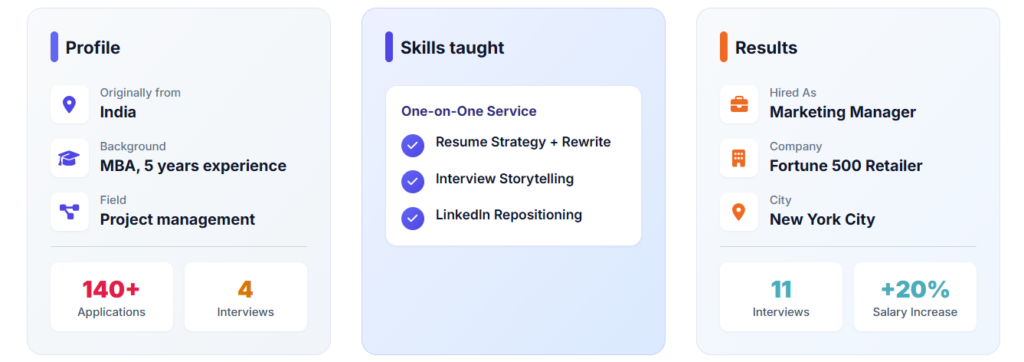
Rebecca was one of my earliest students, back when I was just starting out.
I taught her communication skills for resume writing, interview and offer negotiation.
She trusted me and kept sending me updates. What worked. What didn’t.
That feedback helped me improve what I teach and shaped how I teach today. I am forever grateful for that.
But what struck me most about her was her speed. She made decisions fast. And she acted on them even faster. She didn’t wait for the “perfect” moment. I loved that about her from the first time we met.
So when she told me what happened in her interview, I wasn’t surprised.
“You got the job.” The hiring manager said this in the middle of the interview.
It’s a project management job in NYC. In construction. An industry Rebecca had never worked in.
“I just kept thinking… This is happening. This is really happening.”
We both know the path to that moment. It wasn’t easy.
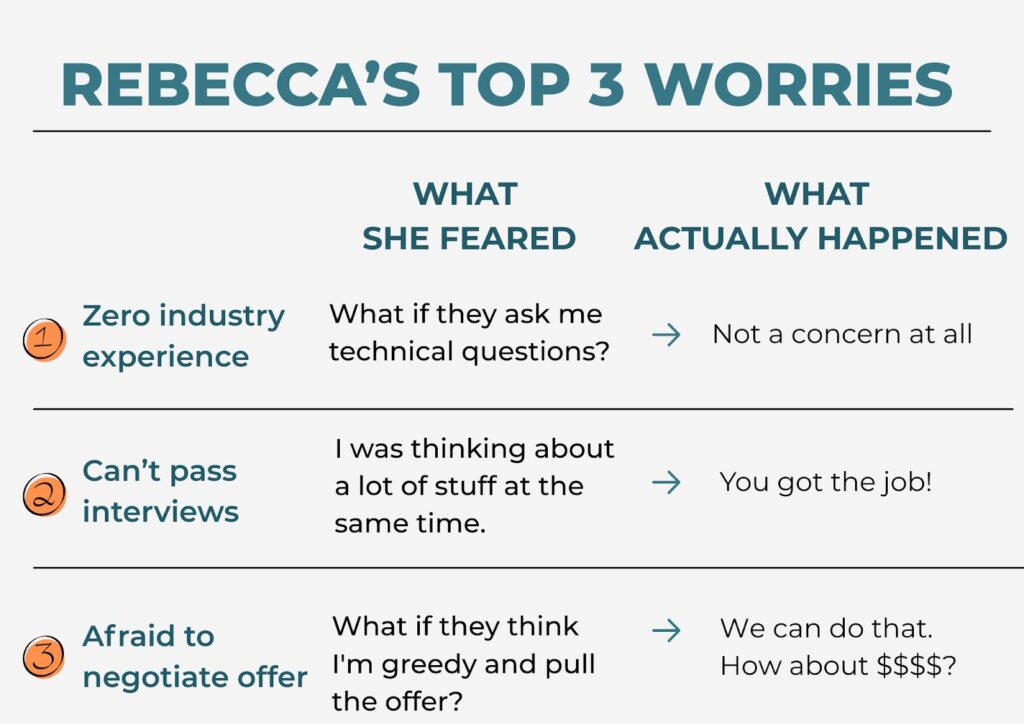
What happened in between?
I wanted to share the 3 areas above where she grew the most.
I picked them because they’re the same challenges I see in many other job seekers I work with.
If you’re going through something similar, I want you to see what’s possible.
BSTACLE NO. 1: BREAK INTO A TOTALLY NEW INDUSTRY
Rebecca had zero construction experience.
——–picture form https://buildingcongress.com/report/2025-2027-new-york-city-construction-outlook-report/
Behind her rapid pace is her confidence in the growth of New York’s construction market, believing that ‘timing outweighs choice.'”
She was nervous: “Is this a deal breaker?”
How We Broke It Down:
We turned this giant scary problem into small, clear steps:
Step 1: How do we know entering this specific industry is a right decision?
“Constrution industry allows me to speak my native language- Spanish. I have an advantage that way.
“I also did research and I noticed construction companies were looking actively for employees.
I don’t have a specific reason to try any new industry at the moment, but living in New York City exposes me to those opportunities. Why not give it a try?
My advice – That’s exactly how I would evaluate whether a new industry is worth a try – industry is growing or declining, does this require certain credentials that are achievable in a short amount of time, to get it does it depend on a heavy network?
It’s the right decision for her.
Step 2: Is no industry experience really a deal breaker?
“No,” I told her. “You have transferable skills. Tons of them. Project management skills work in any industry. It’s doable.”
Step 3: How do you show you are interested in this industry?
“I need to explain why I want to get into construction. And what I’ve done so far to learn about it, for example, I got a new certification, the OSHA 40 which most job descriptions require.”
That’s a communication problem. Not an experience problem.
Step 4: How do you prove to the interviewers that you have potential to grow in this industry?
Again—that’s a communication problem.
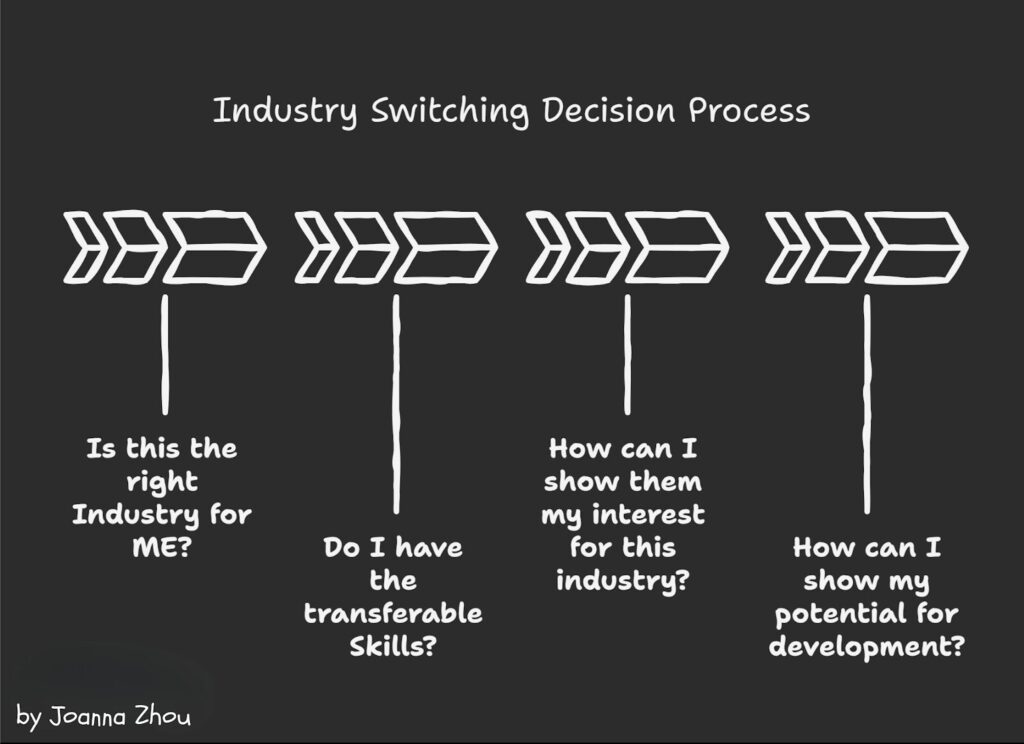
The Shift:
What looked like a missing qualification was actually just a communication challenge.
She knew exactly what to work on next.
The Turning Point in the Interview:
The hiring manager asked: “Do you have any questions for me?”
Rebecca asked: “What makes your employees stay at this company?”
His reaction:
- He looked surprised
- Took a while to reply
- Said, “Give me a couple of minutes”
- His expression changed completely
- His body language shifted
“I could tell he realized I was different from other candidates,” Rebecca said. “His focus was completely on me. Like I got him.”
That one question—plus all the small communication changes we practiced—turned Rebecca from just another candidate into the person they wanted.
Right there. On the spot.
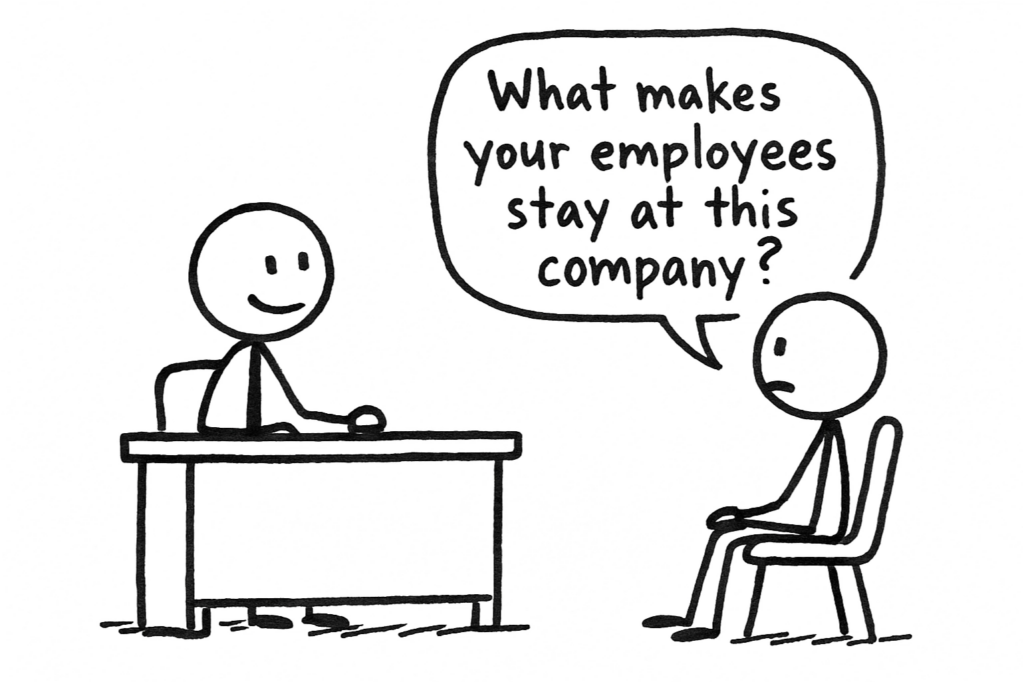
Asking “Why do people stay here?” is a smart move. It changes the vibe of the interview—instead of just checking if you’re good enough for them, the interviewer now has to prove that the company is good enough for you.
If you want to sound a bit more polite or natural, you can try asking it like this:
- “How long has your team been together? What do you think makes them want to stay?”
- “What is it about this place that makes people want to build a long-term career here?”
OBSTACLE NO. 2: COULDN’T PASS INTERVIEWS
Rebecca got interviews. She just couldn’t convince hiring managers she was the one.
Why:
- Cultural clash: “Back in Mexico, being humble is everything. We say ‘we,’ not ‘I.’ We talk about the team, not ourselves.”
- Didn’t know HOW to talk about her value: “I was thinking about a lot of stuff at the same time. I didn’t have a clear speech. I didn’t know how Americans would understand what I already know.”
How We Solved This:
1. We pulled out her best experiences. We figured out exactly WHAT to say. Not every experience is useful.
2. We structured her answers
Clear and powerful. Sentence by sentence. Word by word.
3. She practiced
We worked on HOW to say it. She realized she wasn’t lying about anything. The practice quietly changed how Rebecca saw herself. And that gave her confidence.

So many people do this the wrong way – they copy scripts from online and rarely spend time digging out their career stories (the meat part)
OBSTACLE NO. 3: DIDN’T KNOW OFFERS COULD BE NEGOTIATED
“In my culture, we don’t negotiate,” Rebecca said. “What you get is what you take.”
Extra Worries:
“What if they think I’m greedy and pull the offer?”
“I’m worried about my English. I’m not sure I can handle such a delicate conversation.”
How Rebecca Negotiated Thousands More:
Step 1: She called me right after getting the offer.
Step 2: I looked at her base salary and overall package. I believed there was room for more.
Step 3: Rebecca was worried. I had to convince her about my beliefs.
Step 4: I gave her the exact words to send to HR. Plus three possible responses they might give. And our next step for each response.
Step 5: Before she sent it, I made sure she understood: There’s no losing here. Worst case? The package stays the same. The offer won’t disappear.
Step 6: HR’s answer was exactly the one we predicted.
She first called me around 1pm.
By 3pm, she got a few thousand dollars more in bonus.
Bam!
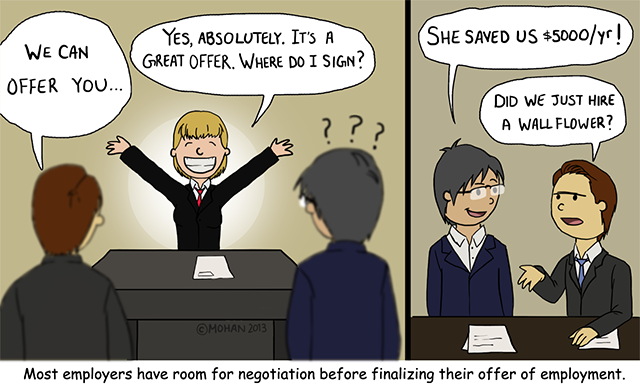
*Image Credit: https://careeraviators.wordpress.com/2013/03/15/an-article-for-new-graduates-in-transition-the-multiplier-benefit-of-salary-negotiation/
KEY TAKEAWAYS—WHAT MOVED ME THE MOST
1. Changing industries isn’t about perfect qualifications
Many immigrants have to switch industries, or want to explore new fields in the US.
The key? Break down this giant scary project into small specific problems, then tackle them one by one, one at a time.
I followed the same process for most job seekers who are switching industries.
Most often, those problems are NOT about what you lack.
They’re about two things
- WHAT you say (valuable things you can pull from your past experiences)
- HOW you say it (express it in a way that can convince someone you’re worth hiring).
2. DO NOT copy Rebecca’s exact question
The question Rebecca asked,”What makes your employees stay at this company?”,worked for HER situation.
It works best for companies still building their culture. Companies where leadership is still figuring things out.
It made Rebecca’s boss stop and think.
Don’t ask this at big companies with an established culture. It won’t make you stand out. It just opens the door for them to brag.
Learn the strategy behind the question. Then create your own.
3. EVERY offer can be negotiated
You won’t always get what you want. But it never hurts to try.
Your offer won’t disappear if you handle it right.
That’s the BIGGEST lesson I learned working in hiring for 15 years.
Knowing that changed my life.
That mindset allowed me to fight for what I deserved, smartly and with a strong heart.
I want to plant that seed in your head. Even if you’re not ready to negotiate yet.
Related Case Studies
- Zero industry experience:
“What if they ask me technical questions?” - Couldn’t pass interviews:
“I don’t know how to talk about myself.” - Afraid to negotiate:
“What if they think I’m greedy and pull the offer?”
- Zero industry experience:
-
- Zero industry experience:
“What if they ask me technical questions?” - Couldn’t pass interviews:
“I don’t know how to talk about myself.” - Afraid to negotiate:
“What if they think I’m greedy and pull the offer?”
- Zero industry experience:
- Zero industry experience:
“What if they ask me technical questions?” - Couldn’t pass interviews:
“I don’t know how to talk about myself.” - Afraid to negotiate:
“What if they think I’m greedy and pull the offer?”
- Zero industry experience: